


Icons of Hollywood... Mary Pickford, 1892 - 1979


Gladys Louise Smith, otherwise known to the wider world as Mary Pickford, was born on April 8th 1892, to a labourer of English Mothodist heritage and Charlotte, a seamstress of Irish Catholic heritage. She was a year older than her sister, Charlotte (Lottie Pickford) and four older than her brother John Charles Jnr (Jack Pickford). Soon after, their father would die of a haemorrage, leaving the three children and their Mother living in a deeply poor area of Toronto.

Pickford's mother Charlotte was forced to take action and bring in some sort of income, and so boarders would be taken in. She also had her children baptised for a second time, this time as Roman Catholics as their father's family had insisted they be Methodists, and Gladys' middle name became Marie. One boarder was a stage manager for a local theatrical company, and he offered young Gladys, as she was then, and her sister roles in a production of The Silver King (H. A. Jones & H. Herman), while Charlotte was the organist for the show. Gladys would take to acting in Toronto, with her siblings following her, and their Mother would move them to the U.S. in 1901 so that the family could pursue what was seemingly a fruitful enterprise, if just enough to keep them fed and housed.
Gladys was the leading name for their little troupe, touring the country with low-rate companies, earning little but enough. It was here that they would meet other future stars of the Silent Movie era, such as Lillian and Dorothy Gish. It was during this period that one producer felt her name did not suit her and was not appealing enough for a rising star. She took "Mary" as an adaptation of her middle name, and "Pickford" to honour her Mother's family.

After a several years of touring North America and with money running out, Charlotte would visit the famous Biograph Company in New York in the hope that they would take her eldest daughter on in their next production. She was building a name for herself on the stage, but they needed more. While a screen-test for the silent film Pippa Passes (1909) was not the hoped for success, a certain D. W. Griffith took to young Mary, and the next day she filmed her film motion picture Her First Biscuits (1909). She stands in a scene at the end in a white dress, and nothing more. She was paid double what most actors were being paid at the time (typically $5 per day) and given a guaranteed wage for a weeks' work.
Little did anyone know that this was the first step on the path for one of the most significant women in cinema.
Films back in this era were short. typically. Mary would film over 40 between May and December of 1909 all for Griffith, with credit for writing three (of which one she did not appear in). There were then 34 in 1910 for Biograph, working with Griffiths and Frank Powell. By now, she was getting well known and wanted, and she was loving her life. After 4 roles and another screenplay for Biograph, Carl Laemmle came calling with his Independent Motion Picture Company (IMP). Most of these 41 films are lost - only 13 survive in their entirety. She then had a brief spell with Majestic in late 1911, with only 5 known films, before returning to Biograph and working with Griffith again for 24 of the 26 films she made for them between 1912 and 1913.

Now 21, Mary Pickford was a known name having appeared and starred in approximately 150 films, all within a 4-year period. Can you imagine that now?

In 1913, Mary was madly in love with film-making. She was not only a star that producers wanted in front of their cameras and on their posters, she was making her way as a screenwriter and producer. She was signed by Famous Players in Famous Plays, the company that would soon evolve into Paramount Pictures and become one of the first and oldest film companies. By 1916, Mary Pickford was a name being mentioned in the same breath as Charlie Chaplin. They were the two most popular names in cinema, and she was frequently the selling name for films - no other woman had been that popular. By this point, she was earning over $1 million per film, (in excess of $23 million today) on top of £500 per week (£10,000 today). For the time, this was record-breaking.
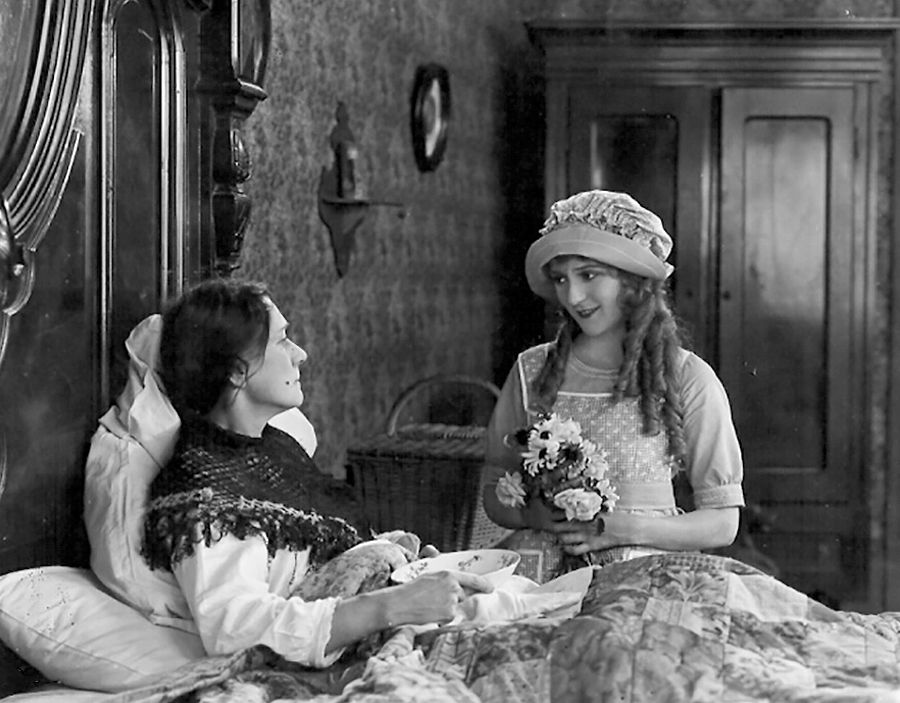
Pickford was known to play children in her early features, mainly due to her youthful looks and short stature. She loved these roles due to her lack of a "normal" childhood. Should would meet Douglas Fairbanks Jnr. as a young boy who assumed she was just a playmate for him. She would oblige happily.
In 1919, Pickford teamed up with Douglas Fairbanks Sr. and her first mentor D. W. Griffith, along with the world's superstar at the time, Charlie Chaplin, to form United Artists, a distribution and production company. This helped continue Mary's passion and vision as not only a star, but a producer as well, something that her previous employers had restricted at times. Her films would regularly gross over $1 million, big money for post World War 1. By the late 1920's, United Artists and Pickford were at the peak of the cinematic mountain. Unfortunately for Pickford, there was a fog that suddenly cleared, revealing a new peak to reach. The era of the "talkies".


Like many early skeptics, Mary didn't really approve of sound and thought it wouldn't do well. Unlike her business partner and future husband Fairbanks Snr, Pickford's career did not flourish with this dawn. But it did bring something she was missing.
Pickford had been America's golden girl. She was loved by critics and audience's alike and, due to the attitudes of the time, this meant that changes didn't always go down well. Mary was known and recognised much because of her signature ringlets of hair. When these were cut for Coquette (1929) and she styled a classic 1920's bob-cut, it was shocking to audiences, bordering on scandalous. She had been the virtuous little American girl (despite being Canadian and in her 30's at this point), and it made national news. While Coquette was ultimately a success and would land Mary her only Academy Award during her active career, her virtuous appeal in America was ending rapidly.

Her niche as an adorable child or feisty teenager/young woman and "girl next door" characters did not carry over into sound films. Women were portrayed as strong, alluring and almost devilish in their roles, using their sexuality to manipulate or win over the hero. This wasn't a fit for Pickford, or so the industry felt. And children were played by children. The early pioneer had now became one of the first cast-offs. Her appeal had gone and new starts were rising.

After retiring from acting in 1933, Mary Pickford was still a respected figure for her earlier work. She returned to the stage for a few years, reprising her role in a stage version of Coquette in 1935, and continued to produce films as vice-president of United Artists until 1956. Throughout her career and after, she promoted support work for struggling actors, funds to build and help medical facilities and support for America's War Veterans and injured.
Pickford would retire in full gradually over the intervening years, slowly fading out of public life. Her mother had passed away in 1928, and both her siblings, who had had short acting careers in the 1920's, had passed away from alcohol-related causes in the mid 1930's. She couldn't have any children of her own, and did not have good relationships with the two children she and her third husband, Charles "Buddy" Rogers, had adopted. Her only surviving familial relationship that was successful was with her niece Gwynne, whom she had taken in when Lottie Pickford had died, although she maintained a strong bond with her stepson Douglas Fairbanks Jr. throughout her retirement. By the 1960's, Mary was almost entirely reclusive. Only a select few would be allowed to visit her, including Fairbanks Jr and her life-long friend Lillian Gish.

Despite having divorced Fairbanks Snr. in 1936 and marrying Rogers a year later, she resided in the estate she and Fairbanks had purchased and that the press had dubbed "Pickfair" for the rest of her life. She had met Rogers in 1927, starring with him in My Best Girl. As their relationship grew, he fell madly in love with her and once they married in 1937, they remained together until her death. Mary still hosted charitable galas and events at Pickfair, but her private social life reduced. She was also the last of the original four founders of United Artists to sell their shares in the company in 1956.
In 1976, she permitted a TV crew into the estate to film her acceptance speech for her Honorary Academy Award for contribution to American film. This was her final public appearance. In her last years, she was able to re-establish her Canadian citizenship, which she thought she had lost, and she was also talked out of her initial promise of destroying her silent film works - which she had been able to maintain the rights to - before her death and instead donated her Biograph works to the American Film Institute.

The legacy of Mary Pickford still holds strong today. I think she would be mortified at the industry, with the treatment of female actors coming to light with the #MeToo movement and the public knowledge of pay gaps only recently coming to light and slowly closing. But Mary would be able to look at the industry and see how what she did in an era where women were still fighting for their right to be heard has carried forward. She could take control of her destiny and her future, and show the world that that was not just a bad thing, but something that benefitted the world in some way. She also built a company that has lasted and helped independent filmmakers be seen and helped forge the business into what we have today. She wasn't "the secretary". She was one of the forerunners.
Her influence has been carried further thanks to the Academy of Motion Picture Arts and Sciences in the 21st Century. They purchased 1313 Vine Street in Hollywood in 2002, which had been a radio and TV studio since 1948. They renamed the building The Pickford Centre for Motion Picture Study, and moved their film archive into it. In 2007, the Academy would go on to press legal action against the estate of Beverly Rogers, Charles Rogers' second wife, in order to stop the sale of one of Pickford's Oscars.

In 2006, construction workers in New Hampshire discovered a reel of Their First Misunderstanding (1911). The film had been considered lost until then, and it is significant because it is the first instance where Pickford was credited by name, and her first film with IMP. She stars alongside Owen Moore, her first husband, who she married on 7 January 1911. The film was released two days later. She was 18. The film has been restored digitally and is with the Library of Congress.
Mary Pickford died on 29 May 1979, in Santa Monica, CA. She rests in the Garden of Memory within the Forest Lawn Memorial Park, Glendale, CA, and is now surrounded by many actors she forged a path for.

Credits -
All information and images gathered from freely available sources on the internet. These include generic Google searches, The Mary Pickford Foundation, Wikipedia, The Academy of Motion Picture Arts and Sciences, IMDB, the BBC and the Women in Film Pioneers Project at Columbia University.
Disclaimer -
This is a summary of Mary Pickford's life. I do not claim to be an expert, and the information has been gathered from sources that may conflict in some details.


Comments